Small gas turbine engines are having a moment. Drones, loitering munitions, cruise missiles, target aircraft, auxiliary power units and hybrid-electric turbogenerators all need compact, powerful engines, and they need them in volumes the industry hasn’t seen before.
The bottleneck sits in the hottest part of the engine. The turbine blisk, a single-piece bladed disk made from nickel superalloy, has to survive extreme heat, stress and rotational speed. It is also one of the hardest, slowest and most expensive parts to produce.
In this post we look at why nickel superalloys are so difficult to work with, how small-engine turbine blisks are made today, and how Tritone’s MoldJet technology offers a new route to producing them.
Why high-nickel superalloys are so hard to manufacture
Nickel superalloys such as Inconel 718, IN713, IN738 and Mar-M247 keep their strength at temperatures where most metals soften or creep. That is exactly why engine designers choose them for the hot section, and exactly why manufacturers struggle with them. The properties that make them perform in service fight back at every step of production.
They resist cutting. Superalloys work-harden as they are machined, conduct heat poorly and stay strong at the hot cutting edge. Tools wear fast, cutting speeds stay low, and machine hours pile up.
The best alloys crack when melted and re-solidified. High-strength grades rely on a large fraction of the gamma-prime (γ′) strengthening phase. Those same grades are prone to solidification and strain-age cracking during welding or laser melting, which limits which alloys can be printed by fusion-based processes.
They react with air when molten. Aluminum, titanium and other reactive elements force melting and pouring to happen in vacuum, adding cost and limiting the number of qualified foundries.
The raw material is expensive. Nickel, cobalt, and in some grades rhenium or hafnium, make every kilogram of scrap and every chip off the part costly.
The geometry is unforgiving. Thin, twisted airfoils with tight tolerances and smooth surfaces leave little room for distortion, porosity or surface defects.
How nickel superalloy parts are made today
Four main routes dominate, and each trades one problem for another.
| Method | How it works | Where it fits | Main limitations |
|---|---|---|---|
| Investment casting | Molten alloy poured in vacuum into a ceramic shell built around a wax pattern | Complex shapes, turbine wheels, blades, vanes | Hard tooling with long lead times, porosity and scrap, limited foundry capacity |
| Forging + machining | A forged blank is CNC-machined to final shape | Larger disks and blisks, highest-integrity rotating parts | Very high material waste, long machining cycles, heavy tool wear |
| Laser powder bed fusion (LPBF) | A laser melts powder layer by layer | Prototypes, complex low-volume parts in weldable alloys like IN718 and IN625 | High-γ′ alloys tend to crack, support removal, rough surfaces, slow and costly at volume |
| Metal injection molding (MIM) | Powder-binder feedstock is injected into a steel mold, then debound and sintered | Small, high-volume parts | Steel tooling cost and lead time, part size limits, design locked once tooling is cut |
None of these routes combines tooling-free flexibility, the ability to process crack-prone alloys and an economical path to volume production. That gap is where small-engine blisks live.
The turbine blisk, and why everyone needs more of them
A blisk (bladed disk) combines the disk and its airfoils in a single piece of metal. Removing the separate blades and their dovetail attachments cuts weight, part count and leakage, and improves aerodynamic efficiency. In the hot section of a small engine, the turbine blisk sits directly behind the combustor, spinning at very high speed in gas hot enough to soften most metals. That is why it is made from nickel superalloy.
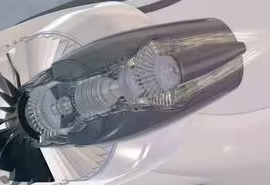
For small engines, typically with turbine blisks around 90 mm in diameter, demand is rising fast for three reasons.
- Unmanned and expendable systems are scaling. Drones, loitering munitions, cruise missiles and target aircraft are being ordered in large numbers. Every one of them needs an engine, and every engine needs a hot-section blisk.
- Cost per engine matters more than ever. An expendable engine may fly once. Programs need hot-section parts that are cheap enough to lose, yet still reliable enough to fly.
- Supply chains are stretched. Superalloy casting capacity is concentrated in a small number of qualified foundries already serving commercial aerospace. New engine makers often wait months for tooling and production slots, and that delay sits directly on their critical path.
The result is a part that is technically demanding, needed in volume, and constrained by how it is made today.ne complex part. It is making them repeatably, at volume and at a competitive cost.
How small-engine blisks are made today
Most small hot-section blisks are investment cast. Larger blisks are usually machined from forgings. Both work, but both are slow to start and costly to change.
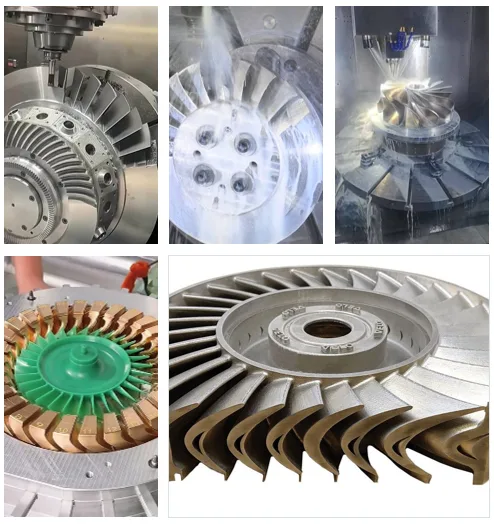
Investment casting: the lost-wax route
- Build the tooling. A metal die is designed and cut to inject wax patterns of the blisk. This step alone can take months and represents a significant upfront investment.
- Inject and assemble wax patterns. Wax copies of the part are molded, inspected and attached to a gating tree.
- Build the ceramic shell. The wax assembly is dipped repeatedly in ceramic slurry and stucco, then dried between coats.
- Remove the wax. The wax is melted out, leaving a hollow ceramic mold.
- Melt and pour in vacuum. The superalloy is vacuum-melted and poured into the preheated shell.
- Knock out and finish. The shell is broken away, gates are cut off, and the part is typically HIPed, heat treated and finish-machined.
- Inspect. X-ray, fluorescent penetrant and dimensional checks catch porosity, inclusions and distortion. Rejected parts are scrapped.
Casting is proven and economical once tooling is in place. Its weaknesses are the upfront tooling cost and lead time, the scrap caused by porosity and shrinkage, and the fact that any design change means new tooling. For a new engine program still iterating its turbine design, that is a heavy penalty.
CNC machining for larger blisks
Larger blisks are commonly machined from a forged superalloy blank on five-axis mills. This delivers excellent material integrity, but the cost is high. Most of the expensive forging ends up as chips, airfoils take many hours to mill, and cutting tools wear quickly in nickel alloys. As blisks get smaller and blade passages tighter, machining becomes even harder to justify.to.
What MoldJet changes
MoldJet is Tritone’s mold-based, sinter-driven additive manufacturing process. Instead of melting metal with a laser, it prints a sacrificial mold layer by layer and fills it with a paste of MIM-grade metal powder and binder. Once printing is complete, the mold is removed and the green part is debound and sintered to full density, just as in metal injection molding.
For nickel superalloy blisks, that approach removes the main barriers of today’s routes.
Proven powder supply chain. MoldJet uses MIM-grade powders, an established and widely available supply base.
No hard tooling. The mold is printed directly from the CAD file. There is no wax die to design, cut and wait for, so first parts arrive in weeks rather than months, and a design change is a new file, not a new tool.
No melt pool, so no solidification cracking. Because the part is consolidated by sintering rather than melting, MoldJet avoids the cracking mechanisms that make high-γ′ alloys so difficult for laser-based processes. That opens the door to the high-temperature grades turbine designers actually want.
Near-net shape. Airfoils come out close to final geometry, cutting the machining hours and material waste of milling from a forging.
Uniform microstructure. Sintering produces an even, isotropic structure without the directional grain and residual stress typical of laser-melted parts. HIP and heat treatment can follow, as with cast parts.
Built for volume. Multiple parts are produced per build, and post-processing uses standard MIM debinding and sintering equipment. That gives a path from prototype to production on the same process.
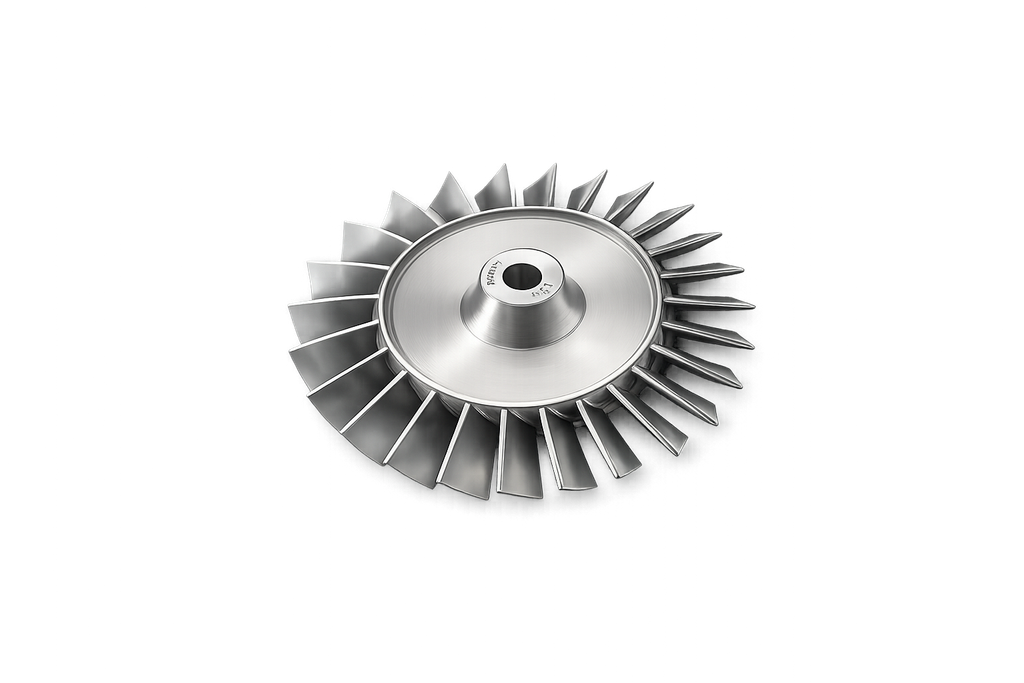
90mm Blisk manufactured using MoldJet. Material: IN713C
| Investment casting | 5-axis CNC from forging | LPBF | MoldJet | |
|---|---|---|---|---|
| Hard tooling required | Yes | No | No | No |
| Time to first part | Months | Weeks | Days to weeks | Weeks |
| Cost of a design change | New tooling | New program | New file | New file |
| Crack-prone high-γ′ alloys | Yes | Yes | Difficult | Yes, via sintering |
| Material waste | Moderate | Very high | Low | Low |
| Path to volume production | Strong, after tooling | Limited by machine hours | Limited by build speed | Multiple parts per build |
A faster route to the hot section
Small-engine programs are moving faster than the traditional superalloy supply chain can follow. Investment casting and CNC machining remain essential, but their tooling lead times, material waste and inflexibility slow down the engines that need to scale now.
MoldJet offers a different path: tooling-free, sinter-based production of nickel superalloy blisks, from first prototype to production volumes, on a single process.
Developing a small turbine engine or sourcing hot-section parts? Contact the Tritone team to discuss your blisk, nozzle or other superalloy component and see what MoldJet can do for your program.