Air has hit its limit
For decades, data centers were cooled the same way: fans pushed chilled air across heatsinks, and hot aisles carried the heat away. That model worked when a rack drew 5 to 15 kW. It does not work when a single AI rack draws well over 100 kW.
Modern GPUs and AI accelerators now run at roughly 1,000 W or more per chip, and the next generations are heading higher. Pack dozens of them into one rack and air simply cannot move heat fast enough. You would need hurricane-grade airflow, enormous heatsinks and fan power that eats into the energy budget meant for computing.
Liquid can carry far more heat per unit volume than air, so it is becoming the default for high-density compute. Direct-to-chip cooling is leading the shift, with immersion cooling growing alongside it. Hyperscalers, colocation providers and server OEMs are now designing liquid in from day one rather than retrofitting it.
What liquid cooling changes inside servers and racks
Moving to liquid redesigns the thermal path from the chip to the facility. Fans and finned air heatsinks give way to a closed coolant loop with several new components, each with its own manufacturing demands.
- Cold plates. Mounted directly on CPUs, GPUs and memory, a cold plate replaces the air heatsink. Coolant flows through fine internal channels just millimeters from the die, pulling heat out at the source.
- Manifolds and quick disconnects. Rack-level manifolds distribute coolant to every server tray. They must be leak-free, serviceable and compact enough to fit in crowded rack space.
- Coolant distribution units (CDUs). CDUs pump coolant, control flow and temperature, and isolate the server loop from facility water through a liquid-to-liquid heat exchanger.
- Heat exchangers. From rear-door units to CDU exchangers, these transfer heat from one fluid to another. Their performance depends on how much surface area can be packed into a given volume.
The result is a server that is quieter, denser and more efficient, but one that depends on precision fluid hardware. The cold plate is where the hardest engineering problem sits.
Why it has to be pure copper
Pure copper conducts heat better than any other practical engineering metal, at roughly 390 to 400 W/m·K. That is close to twice aluminum and many times stainless steel or titanium. In a cold plate, every watt has to cross the metal base before it reaches the coolant, so conductivity directly sets how cool the chip runs.
Purity matters, not just copper. Even small amounts of alloying elements or impurities scatter heat and sharply reduce conductivity. Many copper alloys conduct less than half as well as pure copper. That is why cold plates are specified in high-purity grades such as C10100 or C11000 rather than easier-to-process alloys.
Copper brings other advantages too. It resists corrosion well in standard water-glycol coolants, it is compatible with the copper fittings and tubing already used across liquid loops, and its high thermal mass helps absorb short power spikes from AI workloads.
The catch is that the properties that make copper ideal for cooling also make it one of the hardest metals to manufacture into complex shapes.
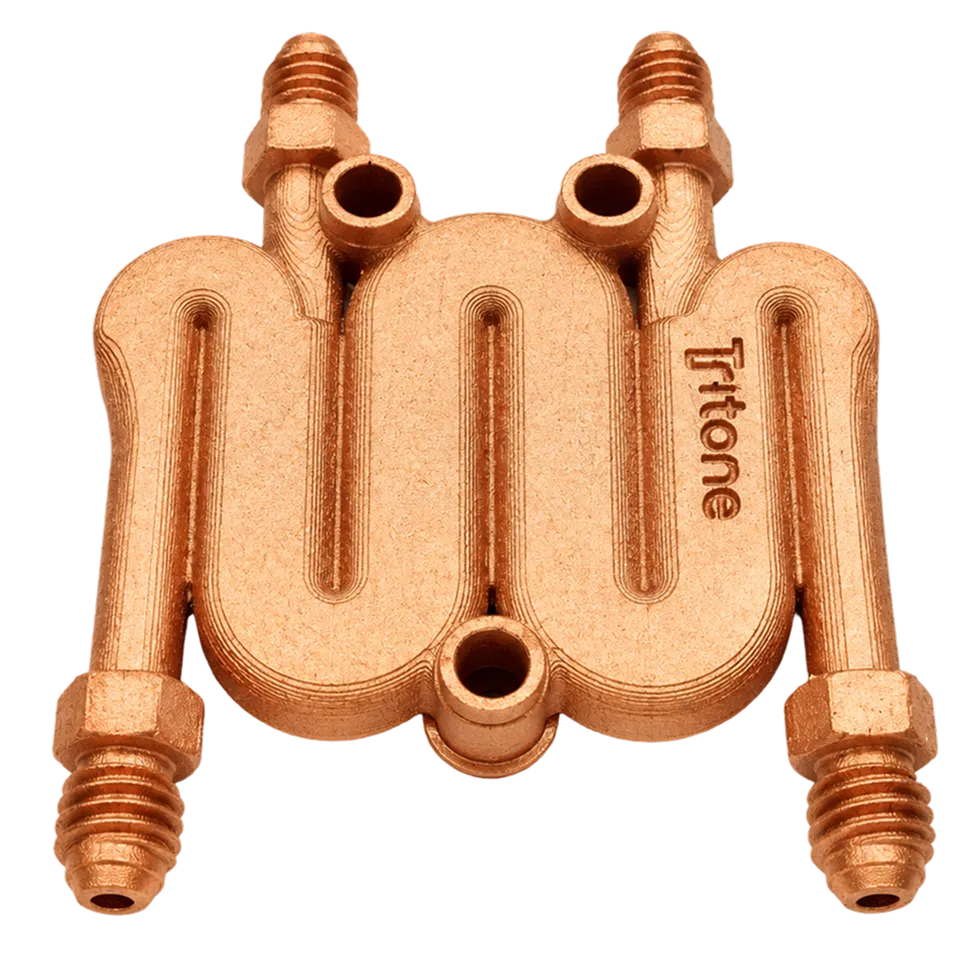
The manufacturing challenge: complex internals in a difficult metal
Cold plate performance is decided by what happens inside the part. Thermal engineers want more surface area in contact with coolant, thinner walls between the chip and the fluid, and flow paths that spread coolant evenly without excessive pressure drop. That leads to designs such as:
- Dense microchannel and micro-fin arrays, with fins and gaps below a millimeter
- Pin-fin fields and jet-impingement features that target hotspots directly over the die
- Curved, branching or variable-section channels that balance flow across the plate
- Lattice and TPMS (gyroid-type) structures that maximize surface area per unit volume
- Integrated inlets, outlets and manifolds that remove extra joints and leak points
Most of these features are fully enclosed, so they cannot be reached by a cutting tool. And copper fights conventional processing at every step.
- It is soft and gummy to machine. Copper smears, forms burrs and wears tools, which limits how fine and deep features can be cut.
- It is hard to join. Enclosed channels usually mean making two halves and joining them. Every joint is a potential leak path and a thermal barrier.
- It is hard to laser-print. Pure copper reflects most infrared laser energy and conducts heat away from the melt pool. Laser powder bed fusion of pure copper needs special lasers and still struggles with density, surface roughness and trapped powder in fine channels.
With AI driving volumes into the hundreds of thousands of cold plates, the challenge is not just making one complex part. It is making them repeatably, at volume and at a competitive cost.
MOST COMMON WAYS TO BUILD COPPER COLD PLATES
Skiving
Skiving uses a sharp blade to slice thin fins up from a solid copper block, one after another. It produces very fine, closely spaced fins with no joint between fin and base, so thermal performance is excellent. It is mature, fast and cost-effective at volume.
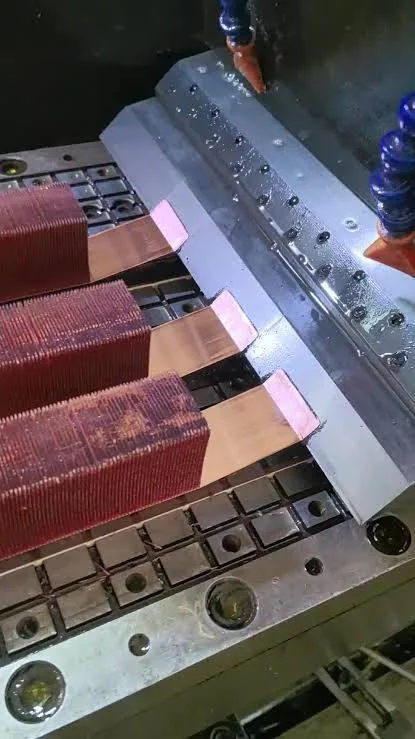
Its limit is geometry. Skiving makes straight, parallel fins and little else. Pin fins, curved channels, variable fin heights or internal manifolds are out of reach, and the finned base still has to be sealed with a cover, usually by brazing or welding.
Brazing
Brazing joins separately machined or stamped copper parts using a filler metal that melts below copper’s melting point. It is the standard way to close skived or machined channels and to build stacked-plate heat exchangers.
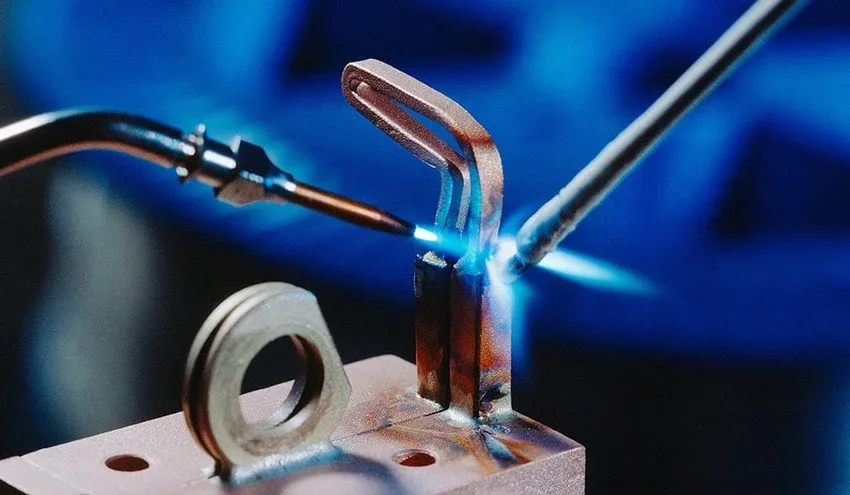
Brazing makes enclosed channels possible, but every brazed joint adds cost, process steps and risk. Filler metal can flow into and block fine channels. Joints add thermal resistance and are a common leak site, which is a serious concern when coolant sits millimeters above a very expensive GPU. Design freedom is still bounded by what each layer can be machined or stamped into.
MOLDJET IS CHANGING THE GAME
Tritone’s MoldJet takes a different approach. A wax-like mold is printed layer by layer, and each layer is filled with a paste of MIM-grade pure copper powder. After printing, the mold is removed and the part is debound and sintered into dense, solid copper.
Because the internal geometry is defined by the printed mold rather than a cutting tool or a laser melt pool, MoldJet sidesteps the main barriers to copper:
Built for volume. MoldJet prints many parts per job and uses proven sintering methods from metal injection molding, supporting the move from prototypes to production quantities.
Monolithic parts. Cold plates and heat exchangers are built as one piece, with enclosed channels, fins and manifolds formed together. No brazed seams means fewer leak paths and no joint resistance.
Design freedom. Pin fins, branching channels, variable cross-sections and lattice structures can be placed where the thermal design needs them.
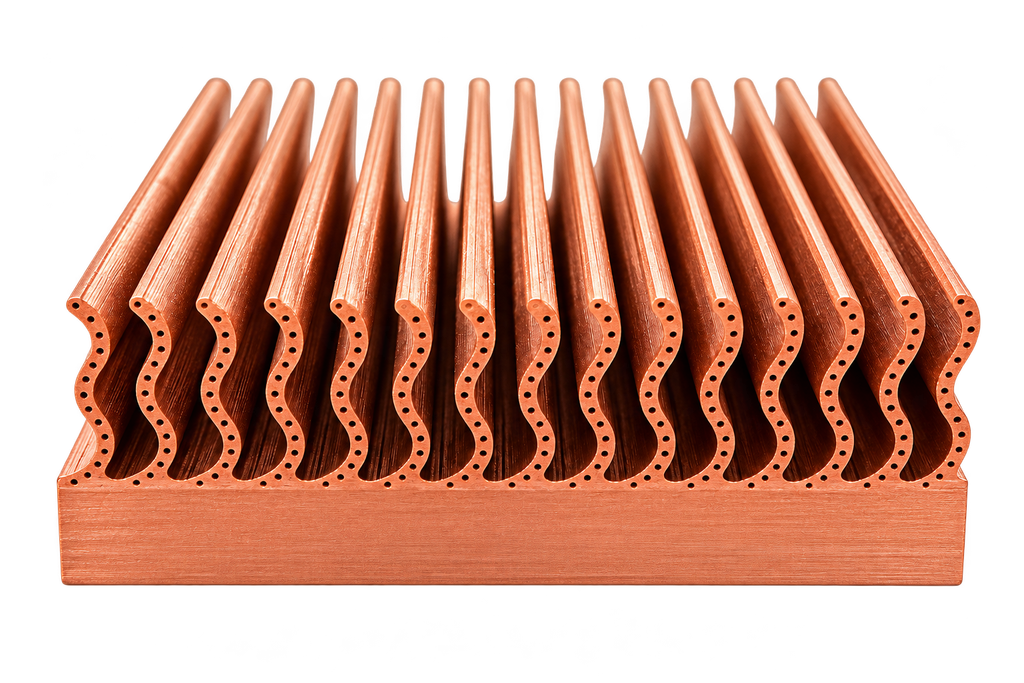
No laser, no reflectivity problem. Copper’s reflectivity and conductivity, the core obstacles in laser powder bed fusion, play no role in a sinter-based process.
at a glance
| Capability | Skiving | Brazing | MoldJet |
|---|---|---|---|
| Fin and channel geometry | Straight parallel fins only | Limited to what each layer can be machined or stamped | Free-form internal channels, pin fins, lattices |
| Enclosed channels | Needs a joined cover | Yes, through joints | Yes, built in one piece |
| Joints and leak paths | At least one seal | One or more per assembly | None in the printed body |
| Material | Wrought pure copper | Pure copper plus filler metal | Sintered pure copper |
| Best fit | High-volume, simple fin designs | Stacked plates, assemblies | Complex, high-performance designs at volume |
The three are not mutually exclusive. Skiving and brazing will remain the right choice for many simpler designs. MoldJet opens the next step: cold plates and heat exchangers whose internals are designed for thermal performance first, not for the limits of the process.
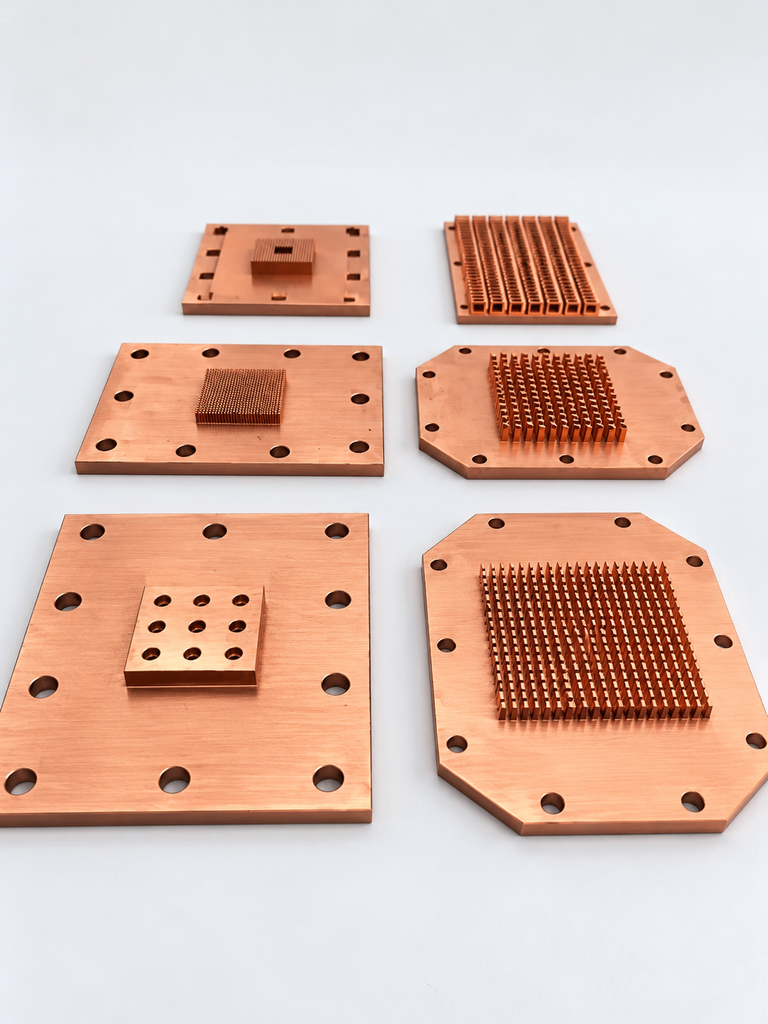
Images from the work done together with the University of Illinois Urbana-Champaign
The next generation of cooling starts inside the part
Liquid cooling is no longer a niche for supercomputers. It is becoming the standard architecture for AI and high-performance data centers, and its success depends on copper parts with internal features conventional methods struggle to make.
As chip power keeps climbing, the gap between what thermal engineers can design and what manufacturing can deliver will decide who leads. MoldJet closes that gap, turning complex pure copper designs into monolithic, production-ready parts.
Developing a next-generation cold plate or heat exchanger? Talk to the Tritone team about how MoldJet can bring your design to production.