
Authors: Shlomi Digorker , Sivan Hazan , Avia Lavon , Ohad Dolev , Matti Ben Moshe , Amnon Shirizly , Galit Katarivas Levy
Sunday 8 March 2026
Abstract
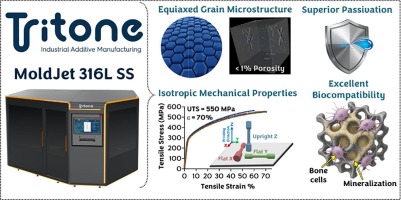
Designing patient-specific metallic implants demands manufacturing routes that combine high density, isotropic mechanical response, corrosion resistance and biocompatibility. This study evaluates Tritone MoldJet, a powder-free, sinter-based additive manufacturing (AM) process, as a route for 316 L stainless steel. We ask whether MoldJet can deliver process-structure–property combinations comparable to or better than established AM and conventional routes used in implant design. 316 L test bulk and lattice demonstrators were fabricated by MoldJet. Bulk samples were characterized in terms of density and pore morphology (X-µCT), microstructure (XRD, SEM/EDS), tensile and hardness properties, and corrosion behavior in phosphate-buffered saline (immersion and electrochemistry). Lattices were used for in vitro osteoblast assays. The resulting property set of the dense samples was benchmarked against wrought, MIM, PBF, DED, BJT and LMM 316 L using materials-property charts. MoldJet 10 × 10 × 10 mm cubes reached 99.9% relative density with predominantly spherical pores (∼70 µm) and a homogeneous equiaxed austenitic microstructure. Tensile tests showed near-isotropic behavior with ultimate tensile strengths of 520–570 MPa and elongations of 60–80%, within the upper range of wrought and MIM 316 L. Corrosion tests indicated low corrosion currents and stable passive films, comparable to or better than literature data for other 316 L routes. Osteoblasts remained viable, adhered and deposited mineralized matrix on MoldJet 316 L scaffolds. Together, these results provide an initial process-microstructure-property dataset for MoldJet 316 L within the tested conditions and dense geometries, offering reference metrics for benchmarking against established 316 L manufacturing routes in implant‑relevant contexts.