
Many AM evaluations begin with a goal to shift from a traditional mfg technology to save on tooling costs or lead times. While the concept is compelling, the reality is that traditional manufacturing excels at producing simple parts efficiently and repeatedly.
Processes such as machining, stamping, and metal injection molding (MIM) are highly optimized for single components. Piece part costs are low and “accepted”, but manufacturers incur many “extra” costs when assemblies are required.
- Assembly labor
- Fasteners and joining methods
- Tolerance stack-up
- Quality inspection across multiple interfaces
- Supply chain complexity
The Hidden Cost of Traditional Manufacturing: Assembly
Modern manufacturing methods like CNC machining and casting are highly advanced –
but they are still inherently fragmented.
Manufacturing is Separate from Assembly
In conventional workflows, each component must be:
* Designed individually
*Manufactured independently
*Post-processed
*Then assembled into a final product
This creates a paradox:
The more complex the product, the more time is spent assembling it – not making it.
In real-world examples like suppressors, dozens of internal elements (baffles,
spacers, threaded mounts) are machined separately and then assembled into a
final unit.
Precision Mismatch & Post-Processing
Even with high precision machining:
*Threads often require secondary finishing
*Interfaces between parts need tuning or adjustment
*Tolerances stack across multiple components
In assemblies like suppressors:
*Thread alignment and sealing are critical
*Misalignment can affect performance or require rework
*Assembly becomes not just a step—but a risk factor.
Part Consolidation 101
Part consolidation is the process of combining multiple discrete components into a single, monolithic design that performs the same or enhanced function. In traditional manufacturing, complexity is penalized. In AM, complexity brings rewards.
Rethinking Suppressor Manufacturing
Suppressors are a classic example of high internal complexity + tight tolerances + heavy assembly dependency.
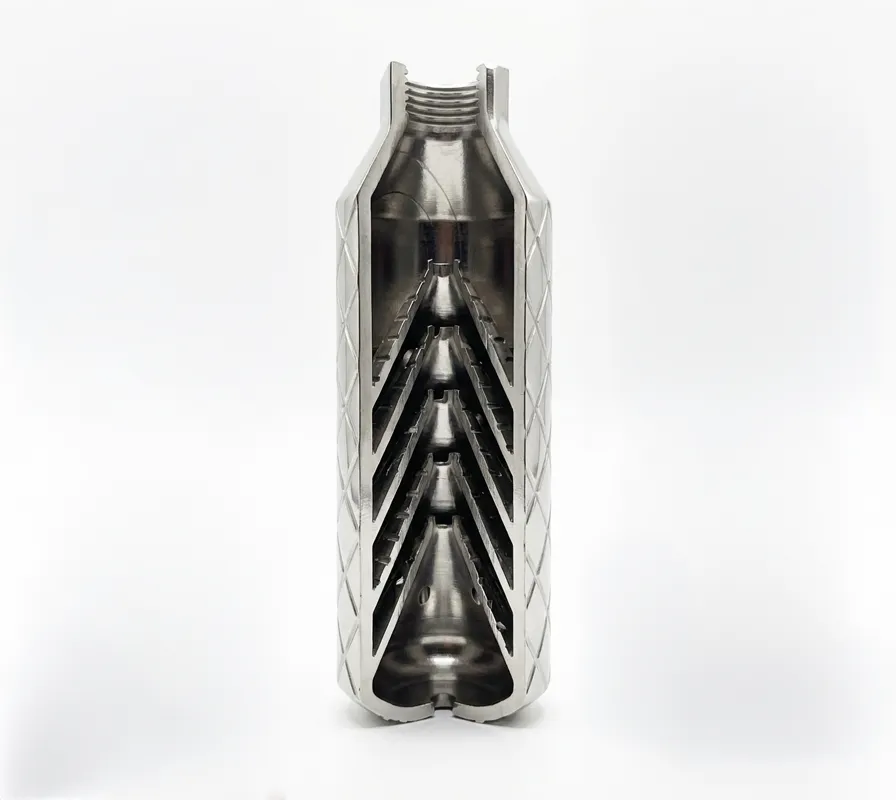
Traditional suppressor designs rely on multiple baffles, spacers, and housings assembled into a final structure.
Challenges include:
- Complex assembly sequences
- Alignment sensitivity
- Performance variability
- No assembly interfaces
- Maintenance and durability concerns
- Additive manufacturing enables a fully integrated suppressor core with:
- Continuous internal flow paths
- Optimized gas expansion geometries
- No assembly interfaces
- Maintenance and durability concerns
The MoldJet Approach – Printed as a Single Unit
Process:
Entire suppressor – including:
1. Internal baffles
2. Flow channels
3. External body
4. Threads – is produced in a single print cycle
Key Advantages:
True one-piece construction » no assembly
Threads printed to final geometry » no secondary machining
No tolerance stack-up
Internal geometries optimized without assembly constraints
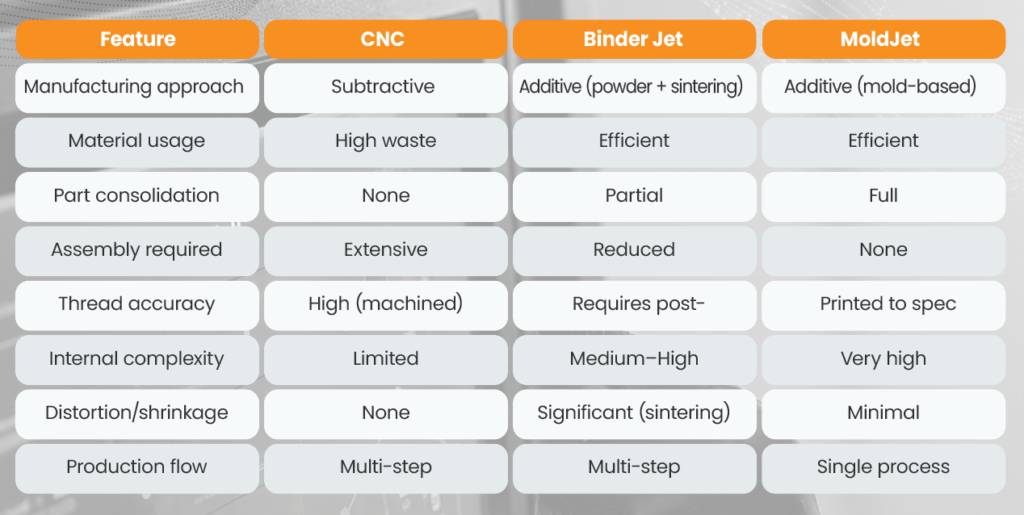
In the end, the most powerful part you can print is the one you no longer need to assemble.
The industry often asks: What can additive manufacturing do that traditional methods cannot?
A better question is: What can additive eliminate?
When viewed through the lens of part consolidation, AM is not simply another way to make parts—it is a way to remove parts entirely.
For sinter-based technologies competing in higher-volume markets, this distinction is critical. Without consolidation, the business case is often weak. With it, AM can redefine both product performance and manufacturing economics.
Assembly has long been accepted as a necessary step in manufacturing.
But with technologies like MoldJet, assembly is no longer a requirement—it is a limitation.
By consolidating multiple components into a single manufactured unit, companies can achieve: Faster production, better performance, lower cost higher reliability. To download the full eBook click here